News
Structured Medication Reviews (SMRs) for Older People: Why They Matter and How PCNs and Neighbourhood Teams Can Confidentially Carry Them Out
16 October 2026
News
16 October 2026
I have been working on the issue of problematic polypharmacy with Health Innovation Wessex and the wider Health Innovation Network for well over 10 years. In this blog, I will share what I have learned about tackling problematic polypharmacy through looking at polypharmacy prescribing data, working with a range of clinicians, listening to patient stories and working with patient organisations like Age UK.
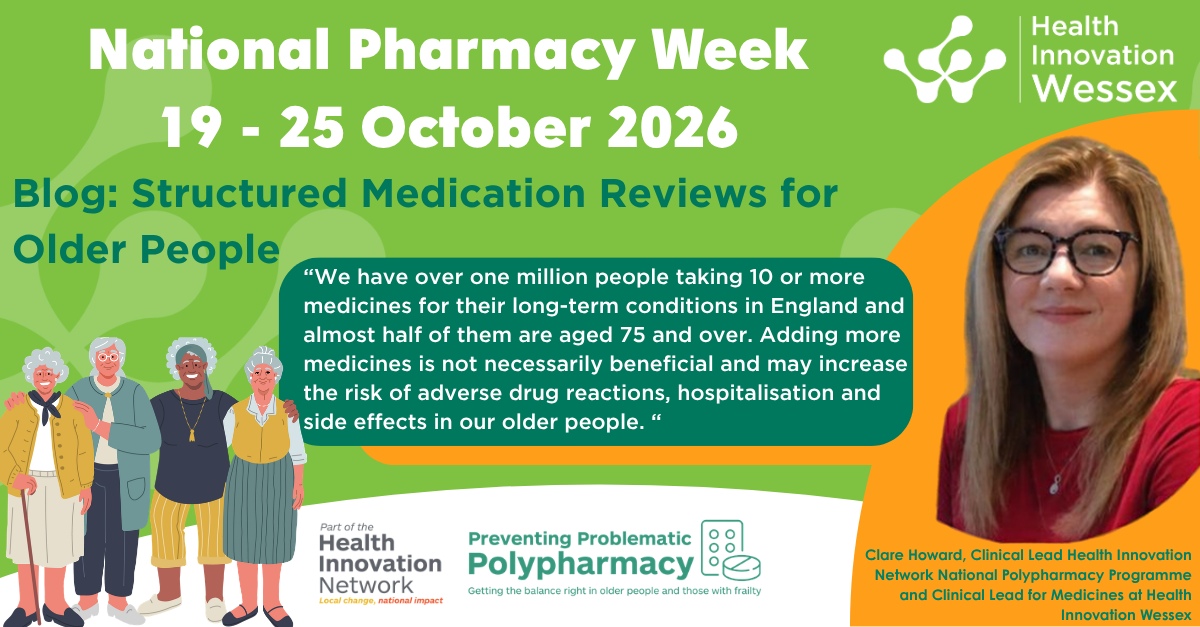
We have over one million people taking 10 or more medicines for their long-term conditions in England and almost half of them are aged 75 and over. Whilst these medicines help many people to live longer, as we reach our older years, adding more medicines is not necessarily beneficial and may increase the risk of adverse drug reactions, hospitalisation and side effects in our older people. Much of the harm from polypharmacy is avoidable. A study in the northwest of England showed that 16.5% of hospital admissions were due to adverse drug reactions, with polypharmacy being a major issue.
Polypharmacy and overprescribing are health system problems. And as such, they will only be addressed properly when health systems get together and think about how to make sure our older people are only prescribed the medicines that they really need and want. Whilst this is a complex challenge, I come across many NHS organisations that are starting to work to address this. There are common areas that I see in their work and that have formed the basis of the Health Innovation Network Polypharmacy Programme.
Over 10 years ago, I was discussing this issue with a GP colleague and he stated very clearly, that understanding local prescribing data was vital to starting to address problematic polypharmacy. So, we created the NHSBSA Polypharmacy Comparators.
PCNs and neighbourhood teams can now look at their polypharmacy prescribing data and understand how many of their patients are taking either quantities of medicines or combinations of medicines that evidence suggests can increase the risk of harm. The patients who are in those cohorts can then be prioritised for a Structured Medication Review.
A Structured Medication Review is a NICE-defined intervention that has been shown in a number of studies to help patients and reduce health care costs.
The iSYMPATHY study carried out in Scotland and Ireland has really set out the economic case. For every 100 Structured Medication Reviews carried out there are:
We know that done well, patients really value the Structured Medication Review appointment.
The PCNs that I see are addressing this have good multidisciplinary working – they make the most of the skills of clinical pharmacists and pharmacy technicians. The clinical team have agreed roles and responsibilities and understand how many and which of their patients are at risk from harm from polypharmacy.
In recent years, we have developed the Structured Medication Review resources to help PCNs invite patients to their Structured Medication Review appointment in a way that they can understand the benefit of the appointment and how to get the best out of it.
When we first published the polypharmacy prescribing data, it very quickly became obvious that GPs and some of the pharmacists (who had started working in general practice then) didn’t have the confidence to stop medicines that were no longer needed. Perhaps those medicines were originally started by another clinician or, more often than is safe, we don’t really know why a medicine was started and patients may have been receiving it for years. So, a small group of us developed an educational intervention called the 1Polypharmacy Action Learning Set, to support GPs and pharmacists and, more recently, frailty nurses and other prescribers to feel more confident clinically and how have robust processes in place to support this work in a safe and effective way.
As part of these Polypharmacy Action Learning Sets, geriatricians join us on the third session and answer questions from the groups about trickier cases or therapeutic topic that they are struggling with.
One of the geriatricians that we work with on the Polypharmacy Action Learning Sets said, “leaving someone on a medicine in their older years is not a clinically neutral act”. This really struck me – they are so right. In the Polypharmacy Action Learning Sets, we discuss why we might have a lower index of suspicion when we start a medicine and over inflate the risk when we think about stopping a medicine. Our Polypharmacy Action Learning Sets have been shown to improve clinicians’ confidence to do this work well.
It's important to acknowledge too that the evidence has shown that prescribers often overestimate the benefits of medicines and underestimate the risks, especially in older people. So, it’s important that prescribers arm themselves with the evidence.
It’s important to be honest with patients. We need to explain that medicines that were appropriately started in their 40s and 50s to address high blood pressure may no longer be suitable for them in their 70s and 80s. As we age, our physiological reserves to safely consume multiple medicines declines and so the sometime small benefits are outweighed by the risk of side effects like dizziness which might cause a fall.
We need to be honest with our older patients about the fact that we simply don’t have the evidence base to tell us how medicines work in older people with multiple long-term conditions.
We should explain to our older people that we don’t know exactly what these medicines will do, especially for those living with frailty but a Structured Medication Review is an opportunity for patients and their GP or pharmacist to sit down and work out BRAN - what are the:
And we should apply this to starting and stopping medicines in all our older people.
Both the RCGP and Royal College of Pharmacy have issued statements outlining the important of the Structured Medicines Review.
So how do we make this happen?
This work isn’t straightforward and it needs to be built into systems and processes.
PCNs and neighbourhood teams have been given clear mandates to address frailty and care of older people.
It’s extremely difficult for one GP or one pharmacist to try to tackle this in isolation. This needs a team approach where primary and secondary care understand that for older people living with frailty, we need to be very judicious about the medicines we use.
People in their later years may not want medicines that need constant monitoring or regular scans. We should ask them how they feel. And by deploying shared decision making, we can make the care right for that person (which might be different to what we might want for ourselves - but that’s OK).
Help is out there!
I meet many PCNs and neighbourhood teams who are already are doing this work and the HIN Polypharmacy Programme has created many resources to help you work through this. We have captured the learning from those already forging ahead.
This issue, and the harm that it causes, aren’t going away so please do link with us.
Over 4,300 GPs, pharmacists and others have already joined our shared learning network to hear about the latest research, policy issues and outputs.
The successful Polypharmacy Action Learning Set model will now be tested as part of a large study looking at the role of Pharmacogenomics in Polypharmacy extending Wessex's polypharmacy expertise into the pharmacogenomics era.
1Polypharmacy Action Learning Sets (ALSs) are facilitated learning programmes designed to help clinicians develop the knowledge, skills and confidence to manage problematic polypharmacy, particularly when undertaking Structured Medication Reviews (SMRs) and supporting deprescribing conversations with patients.
The Action Learning Sets bring together healthcare professionals, including:
Share
Need more information?
Contact the communications team:
(023) 8202 0858